Required Formats
Reference samples for English proficiency letters, translation formats, and physical fitness certificates for your scholarship application.
Document Guidance for Scholarships
Small document problems cause more trouble than most students expect. A missing stamp, an uncertified translation or a grade entered without an official conversion can hold up an otherwise strong ICCR or COMPEX application. On this page we collect real, privacy-blurred samples of English proficiency letters, notarised English translations of Nepali citizenship certificates, the ICCR physical fitness certificate and the supporting papers COMPEX applicants use. Pick a tab below to see how each document is laid out, then read the notes further down on certification, grade conversion and the errors to avoid.
English as a Subject Samples
English as a Subject - Sample 1
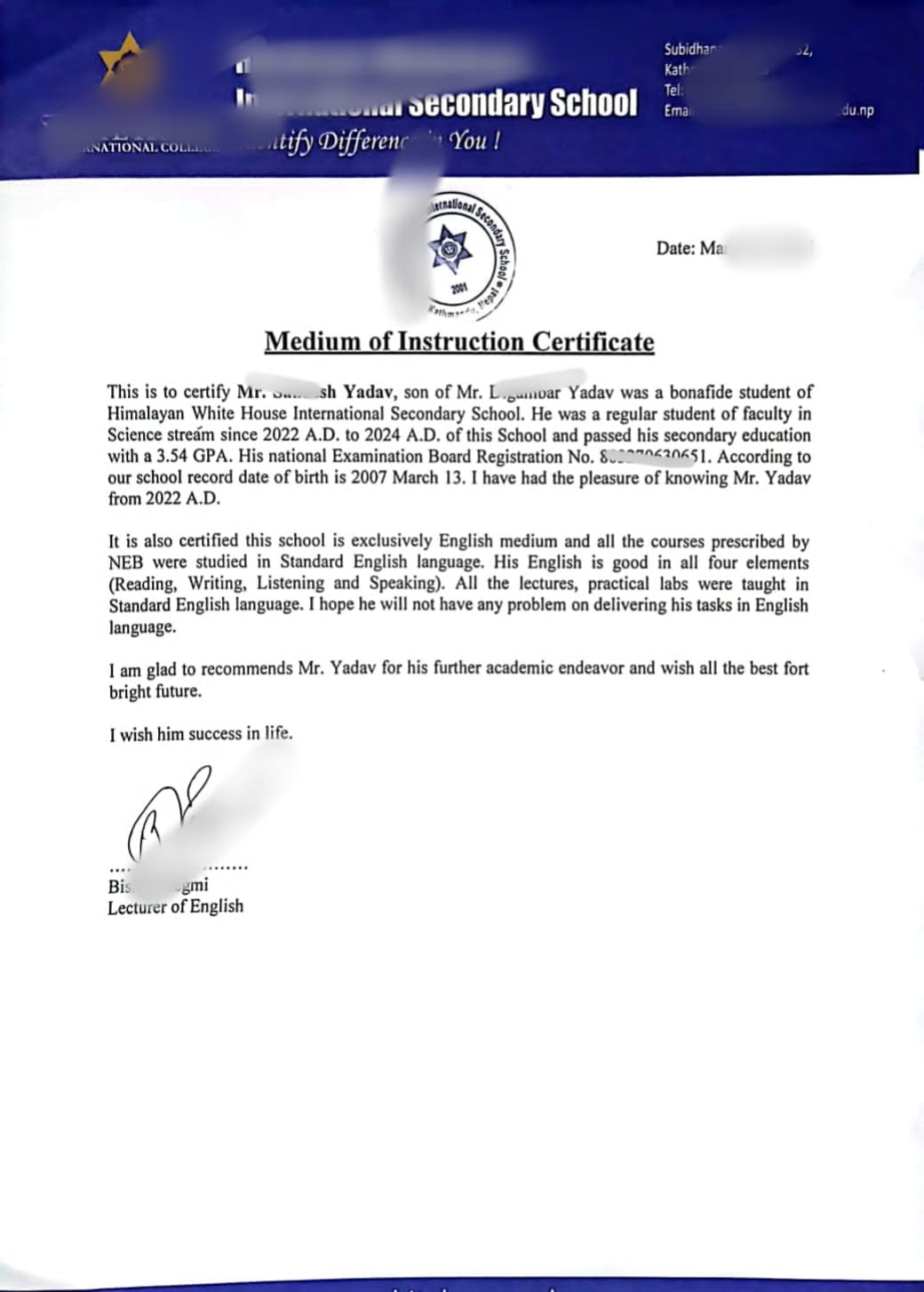
A Medium of Instruction Certificate issued by a Nepali secondary school on its letterhead. It identifies the student, the stream and the years of study, states that every NEB course was taught in English, and is signed by an English lecturer and stamped by the school. A letter like this works as proof that English was part of your studies.
English as a Subject - Sample 2
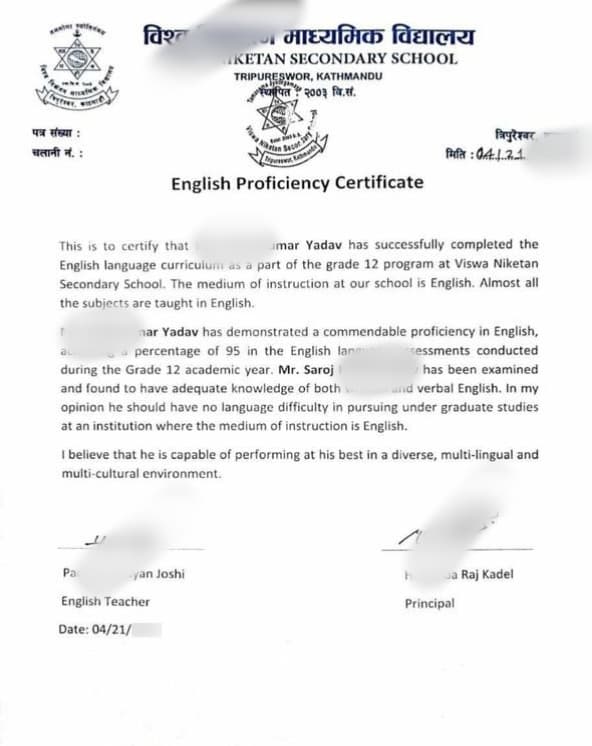
An English Proficiency Certificate from a different school, confirming that the student completed the English curriculum in Grade 12 and that the medium of instruction is English. It carries a reference date, the school stamp and two signatures, the English teacher's and the principal's, which makes it easy for a reviewer to verify.
English Translation Format Samples
Official Translation Format
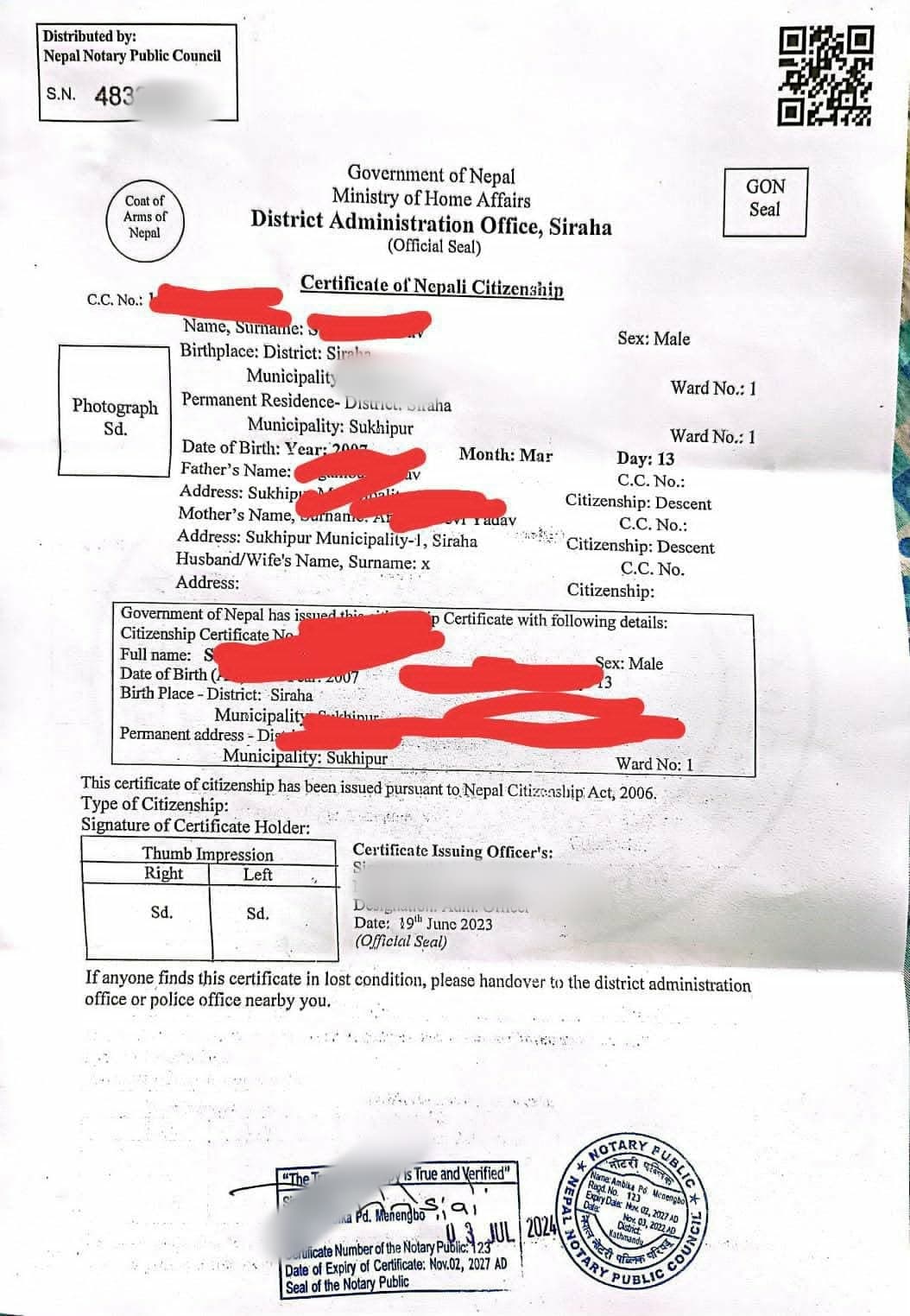
An English translation of a Nepali citizenship certificate that keeps the layout of the original, field by field, from the issuing District Administration Office to the citizenship number and dates. At the foot is the Notary Public's stamp with the words "The Translation Copy is True and Verified", the notary's signature, registration number and date, which is what turns a plain translation into a certified one.
Physical Fitness Certificate Samples
Physical Fitness Certificate 1st Page
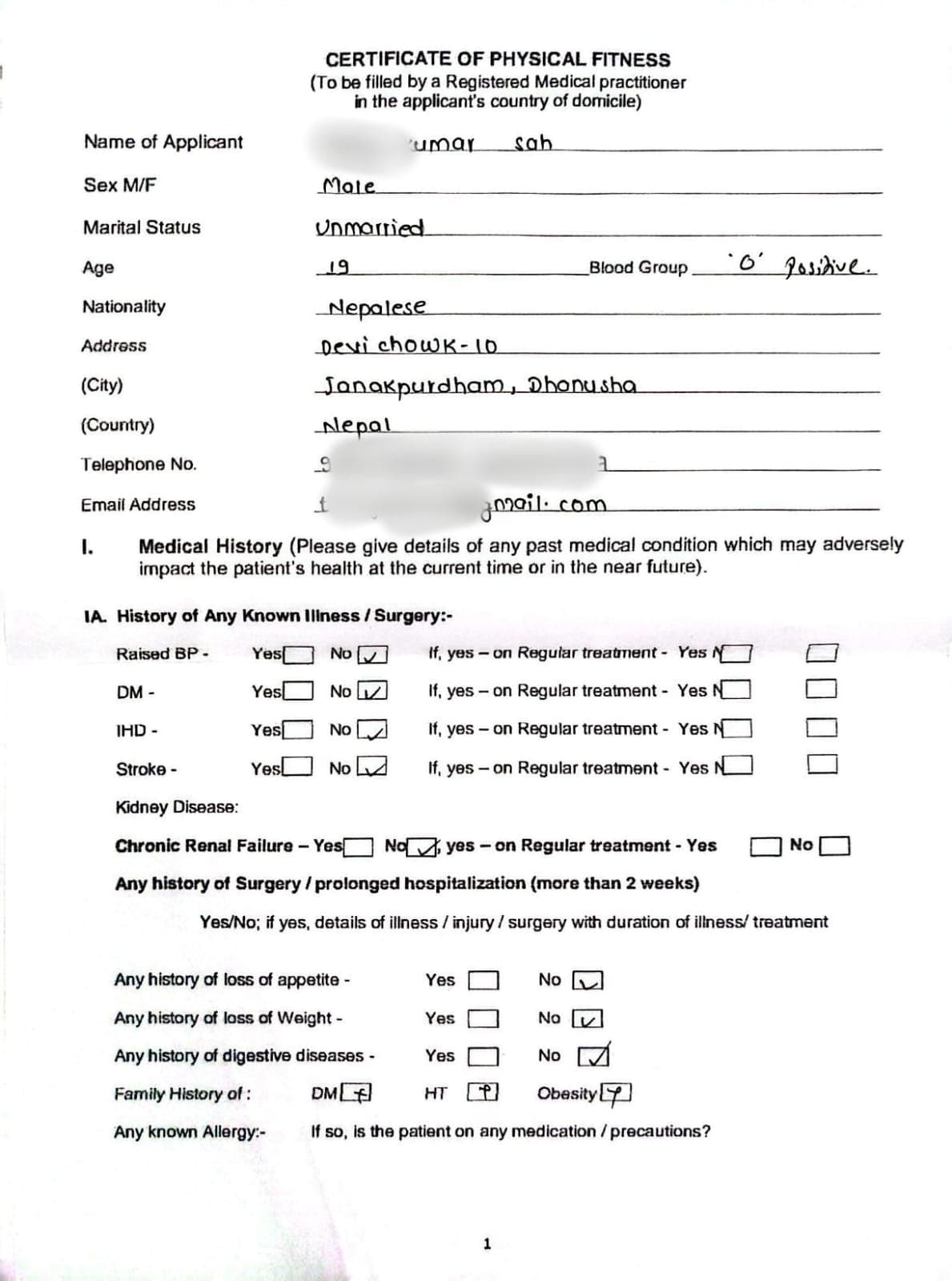
The first page of the ICCR Certificate of Physical Fitness, which must be filled in by a registered medical practitioner in your home country. It records your personal and contact details and blood group, followed by a medical history checklist covering blood pressure, diabetes, heart and kidney conditions, past surgery or long hospital stays, and allergies.
Physical Fitness Certificate 2nd Page
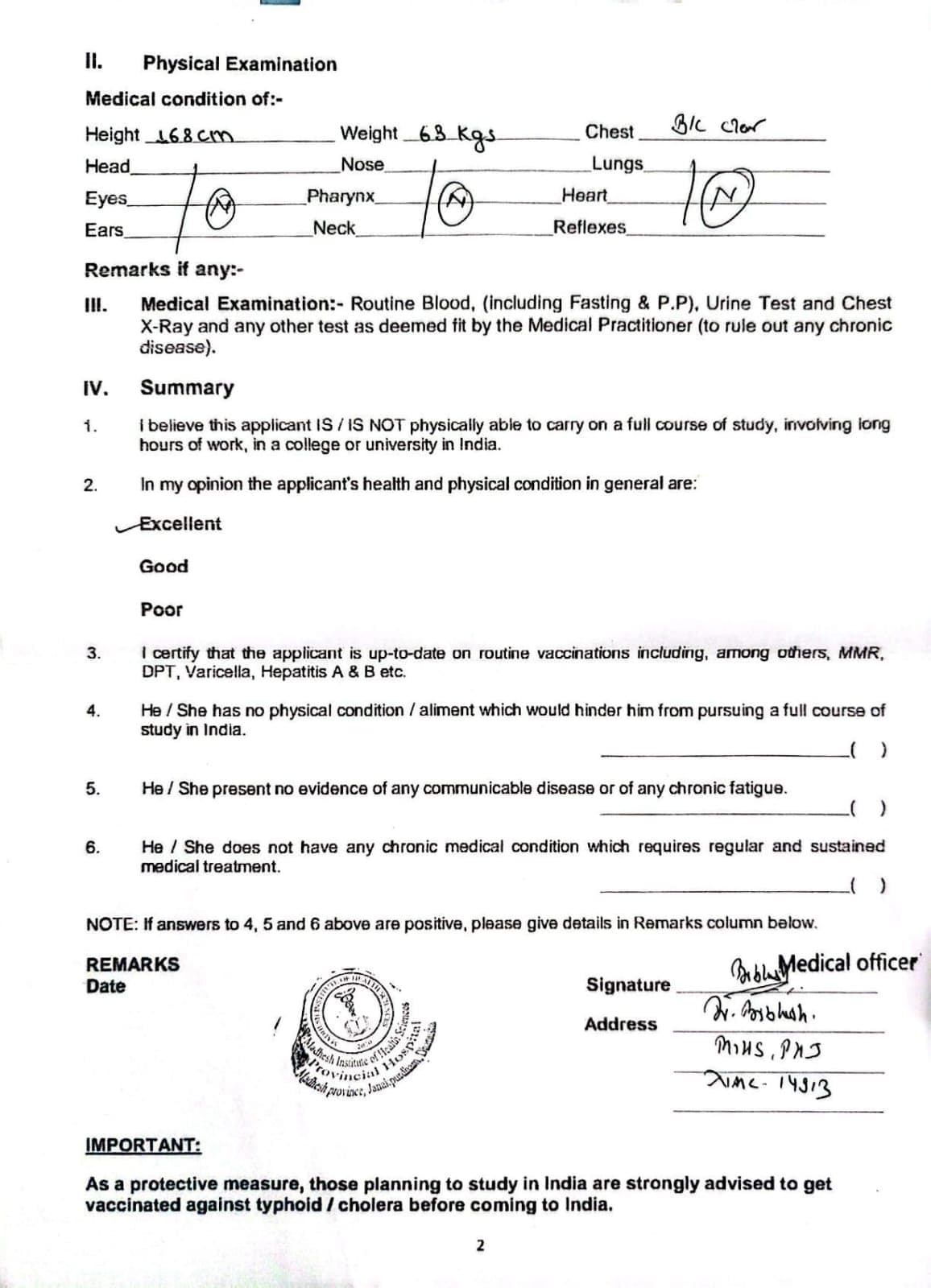
The second page holds the physical examination, the tests the doctor may order such as routine blood, urine and a chest X-ray, and the doctor's summary of whether you can manage a full course of study in India. It ends with the doctor's signature, address, registration number and the hospital seal. Check that no section has been left blank before you leave the clinic. ICCR asks for this certificate only after you receive an offer.
COMPEX Documents Samples
Bank Challan
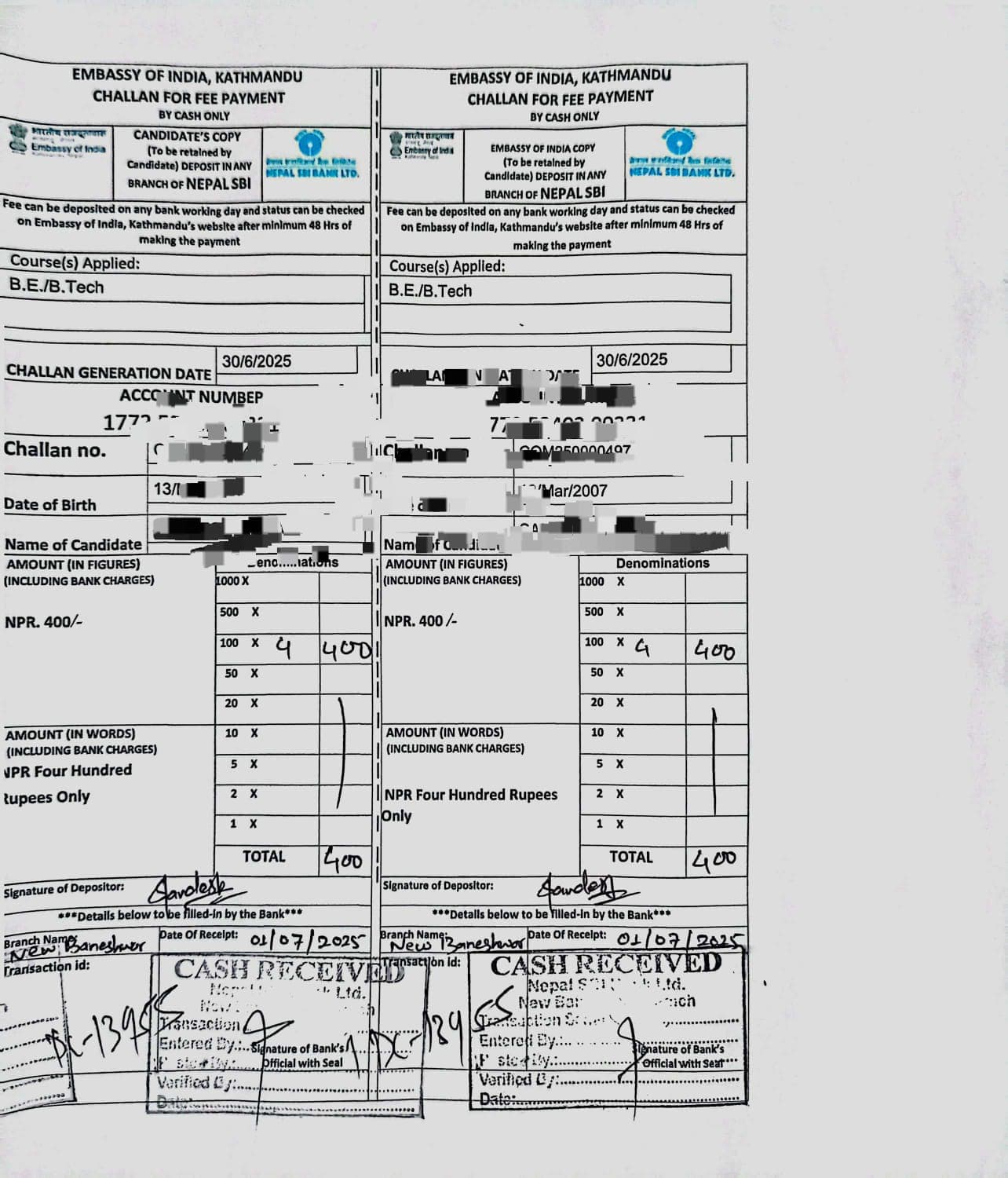
A paid COMPEX fee challan from Nepal SBI Bank. The form has two halves, a candidate's copy and an Embassy of India copy, each showing the course applied for, the challan number, the candidate's name and date of birth, and the bank's cash-received stamp. Keep your copy safe: its details and a scan are needed in the final step of the online application.
Class 10 Percentage Conversion Sample
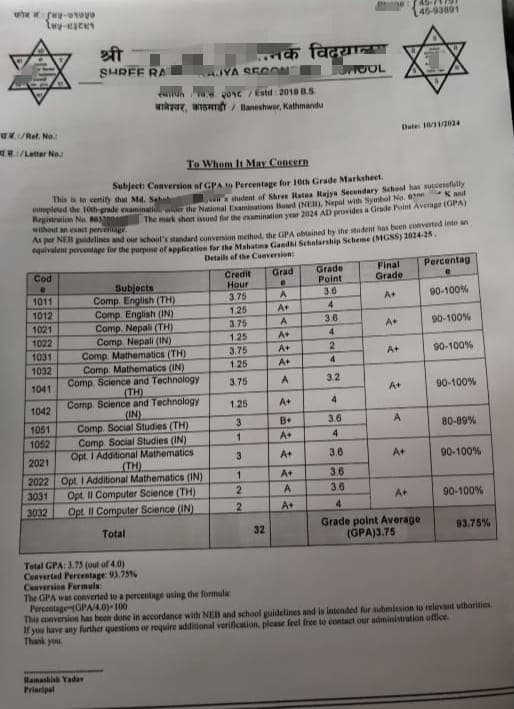
A school letter converting a Class 10 GPA into a percentage. It lists every subject with credit hours, grade and grade point, then states the formula used, GPA divided by 4 and multiplied by 100, and is signed by the principal. Note that this is only one of several conversion methods schools use.
Class 12 Appearing Student Document Sample
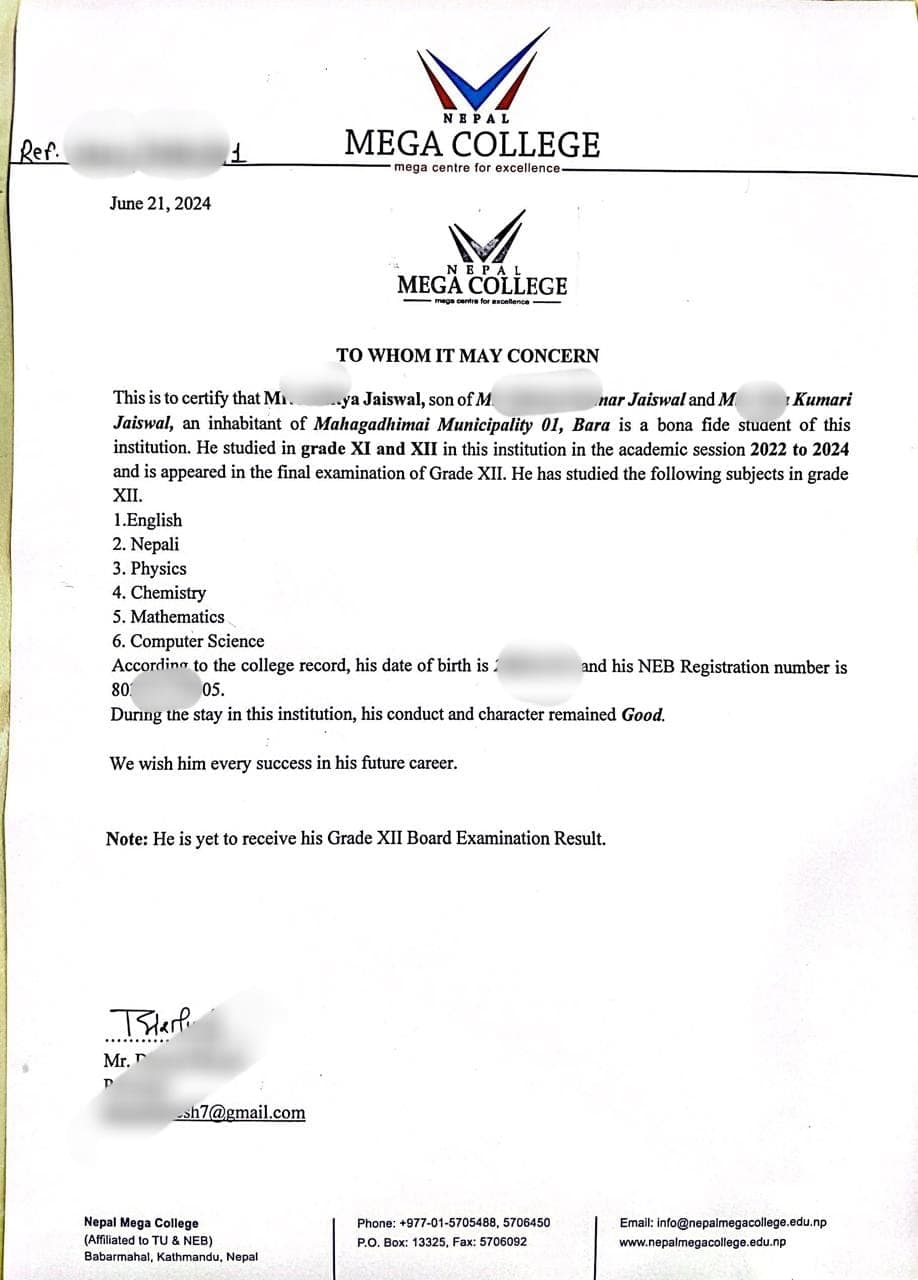
A 'To Whom It May Concern' letter from a college for a student still waiting for Class 12 results. It confirms enrolment in Grades 11 and 12, lists the subjects studied, gives the date of birth and NEB registration number, and notes that the board result has not yet been received. COMPEX accepts appearing candidates who submit a school certificate of this kind.
Class 12 Percentage Conversion
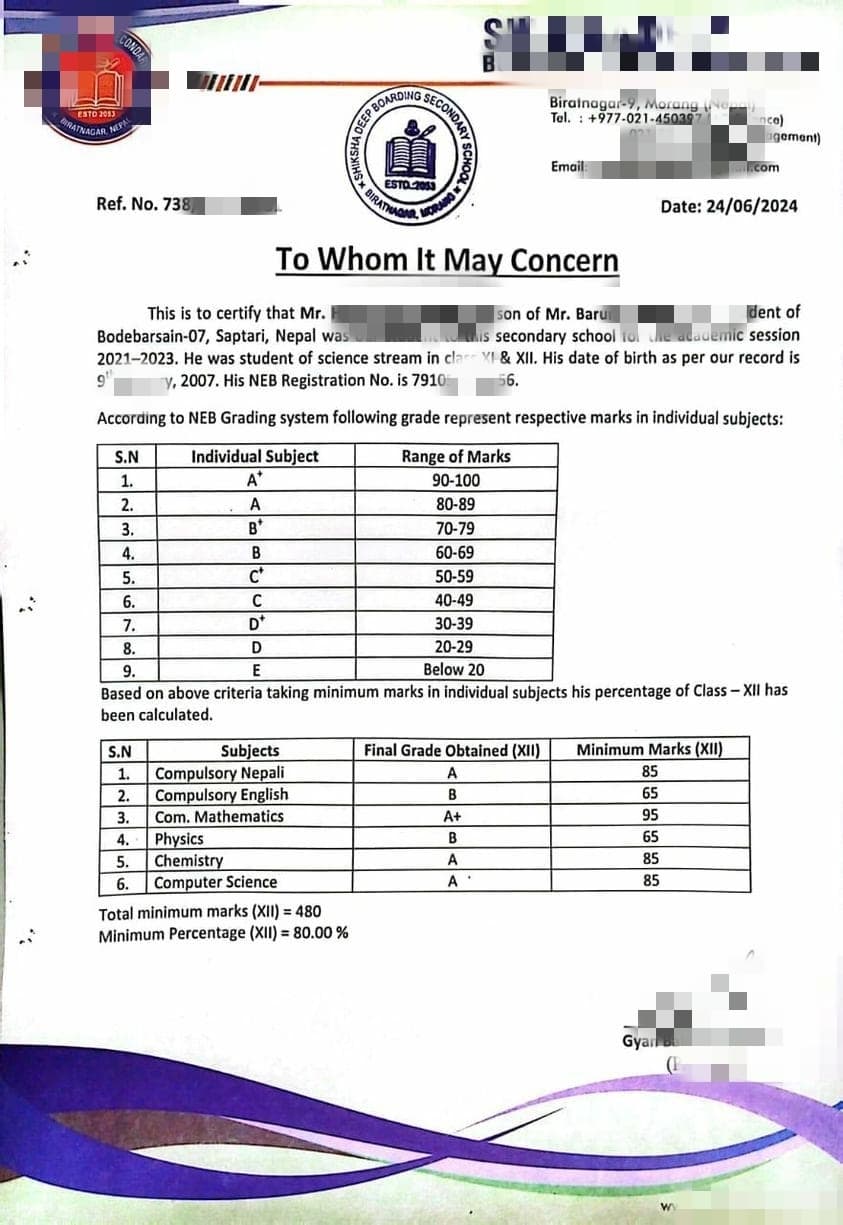
A Class 12 conversion letter that prints the NEB grade bands with their mark ranges and then takes the lowest mark of each band to calculate a minimum percentage. This conservative method gives a lower figure than a GPA-based conversion would, so check which method your scheme accepts.
Class 12 Percentage Conversion Sample
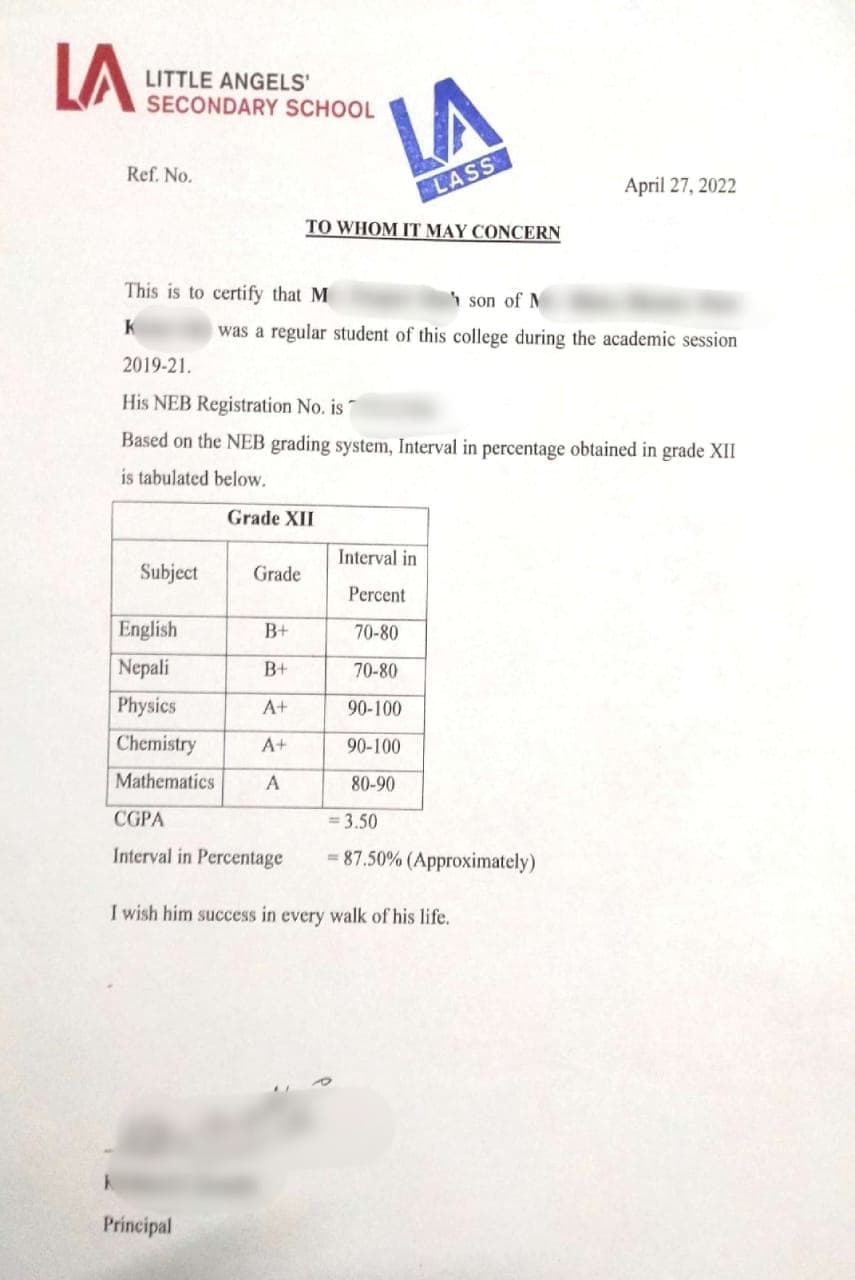
A shorter Class 12 conversion letter that shows each subject's grade beside its percentage interval and states the overall result as an approximate percentage alongside the CGPA. It is signed by the principal and stamped by the school.
English Translation Format
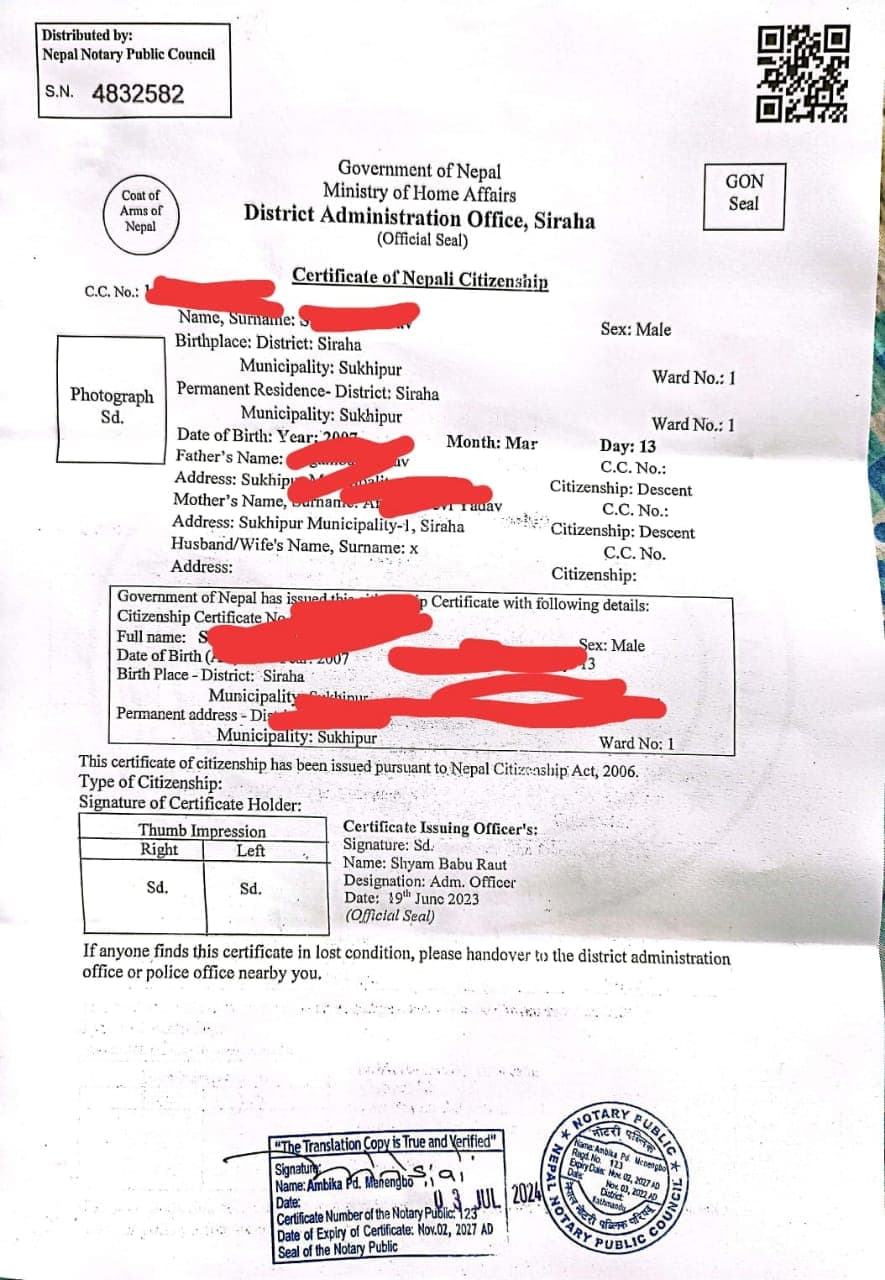
A second copy of the notarised citizenship translation, included in the COMPEX set for applicants who need an English version of a Nepali document. Confirm in the current notice whether your scheme asks for one, and check that the spelling of your name and the date of birth match your other documents exactly.
What each document category is for
The samples above cover the four kinds of paperwork students ask us about most. None of them is a form you simply download and fill in. Each is issued or certified by someone else, such as your school, a notary or a doctor, so the samples are there to show you what to ask for and what the finished document should contain.
- English as a Subject: a letter on your institution's letterhead confirming that you studied English, or were taught in English. ICCR asks for it as evidence of English. Undergraduate applicants usually obtain it from the school where they completed Class 12, and postgraduate applicants from their bachelor's college.
- English Translation: any certificate that is not in English, such as a Nepali citizenship certificate, needs an English version. The SAARC and HJBSS notices specifically ask for the translation to be certified by a Notary Public.
- Physical Fitness Certificate: the medical form ICCR asks for after you receive an offer. It is completed by a registered medical practitioner in your home country and is not needed with the first application.
- COMPEX documents: the fee challan you receive after paying at Nepal SBI Bank, grade-to-percentage conversion letters for Class 10 and 12, and the school letter that candidates still awaiting Class 12 results submit in place of a final mark sheet.
Notarisation, attestation and translation explained
These three words are often used as if they meant the same thing. A translation is simply the English version of a document. Notarisation means a Notary Public has compared the translation or copy with the original and then stamped, signed and dated it, as in the translation samples above. Attestation is the broader idea of an authority vouching for a document, such as a principal signing and stamping a letter on school letterhead.
Read the wording of each notice carefully. ICCR asks for English versions of documents not originally in English. The SAARC and HJBSS notices go further and ask for notarised mark sheets (Class 12, plus graduation for HJBSS) and a notarised translation of the citizenship certificate. Both list plain photocopies of notarised pages, and uncertified papers, among the mistakes to avoid.
Tip: Get translations done once and carefully, and keep the notarised originals safe. Check that names in the translation are spelled exactly as in your passport or the English version of your mark sheets.
Converting grades to percentages
Many schemes state their minimum marks as percentages, while boards such as Nepal's NEB report letter grades and GPA. Look closely at the COMPEX samples above and you will notice they use different methods: one multiplies the GPA, one takes the lowest mark in each grade band, and one gives a percentage interval. The results can differ by several points for the same student.
That is why you should never convert your own grades with a formula found online. If a scheme publishes its own conversion sheet, as Study in India did in 2026, use that for that scheme. Otherwise ask your school for an official conversion letter, and enter only the figure that letter supports. Keep the letter with your mark sheets, since COMPEX candidates whose board issues grades are expected to bring it to document verification.
Common document errors to avoid
Most document problems fall into a handful of patterns. Check your set against this list before you upload anything or post a paper application.
- A name spelled differently across the passport, citizenship certificate and mark sheets, or a date of birth that does not match between documents
- Phone photos with shadows, cut-off edges, or glare over seals and signatures
- Multi-page documents uploaded as separate files, or with pages missing, out of order or upside down
- Letters without letterhead, stamp, date or signature, which a reviewer has no way to verify
- Files over the size limit, or compressed so hard that the marks can no longer be read
- Translations that are not certified when the scheme asks for notarised copies
- Photographs with a coloured background, or with ears hidden, where a white background with both ears visible is required
Preparing your files for upload
Online portals typically expect JPG files for photographs and signatures and PDF files for certificates, each under a size limit stated on the portal. Scan in good light, zoom in to confirm every seal and signature is readable, and combine multi-page documents into a single PDF in the correct order.
Our free browser-based tools can help with each step: the Image Resizer for photographs and signatures, the PDF Compressor for files over the limit, Merge PDF for joining pages, and JPG to PDF for turning photographs of pages into one document. COMPEX applicants can use the COMPEX Document Prep tool, which is set up for that portal's photo, signature and certificate fields.
Using these samples responsibly
The samples show layout and content, not wording to copy. Your school, notary or doctor will issue the real document on their own letterhead and in their own words, and formats can change between cycles. Personal details in the samples have been blurred for privacy.
Never edit a sample to look like your own document, and never submit anything that was not genuinely issued to you. Incorrect information can lead to a scholarship being withdrawn at any stage, even after selection. If an official notice asks for a particular format, the notice always takes priority over anything shown here.
Free tools for preparing your files
Related guides
Scholarship Documents: Scanning, Formats and File Sizes Done Right
How to scan and prepare scholarship documents: clear photos, white-background photo and signature, PDF vs JPG, file-size limits, merging pages and translations.
COMPEX Application Documents: Photo, Signature and PDF Upload Guide
Prepare COMPEX photo, signature, citizenship translation and certificate uploads in the right size and format, avoid common errors and check before you submit.
ICCR A2A Portal Application 2026: Complete Step-by-Step Walkthrough
A practical walkthrough of the ICCR A2A portal: registration, each form section, document uploads, university preferences, submission and embassy follow-up.
Why Scholarship Applications Get Rejected and How to Avoid It
The most common reasons ICCR, COMPEX and Embassy scholarship applications fail, from name mismatches to missed emails, and practical ways to avoid each one.